
Why Use Tags?
Every organization organizes investments differently.
Common tagging strategies include:
- Investment manager
- Fund family
- Business unit
- Client-defined grouping
- General ledger code
- Reviewer assignment
- Internal project categories
Reuse Existing Tags
Previously created tags appear as selectable options, allowing you to maintain consistent naming across your engagement.
Defining a standardized tag library will help deliver consistent reporting and filtering options for your team.
Reporting with Tags
Tags can be used throughout K1 Aggregator to filter investment lists and generate targeted reports.
Examples include:
- All Blackstone investments [tag='Blackstone']
- All Real Estate funds [tag='RE' or 'Real Estate']
- Investments assigned to a particular reviewer [tag='John Doe']
- Investments belonging to a specific GL grouping [tag='GL-1']
This makes it easy to generate targeted reports without manually selecting investments.
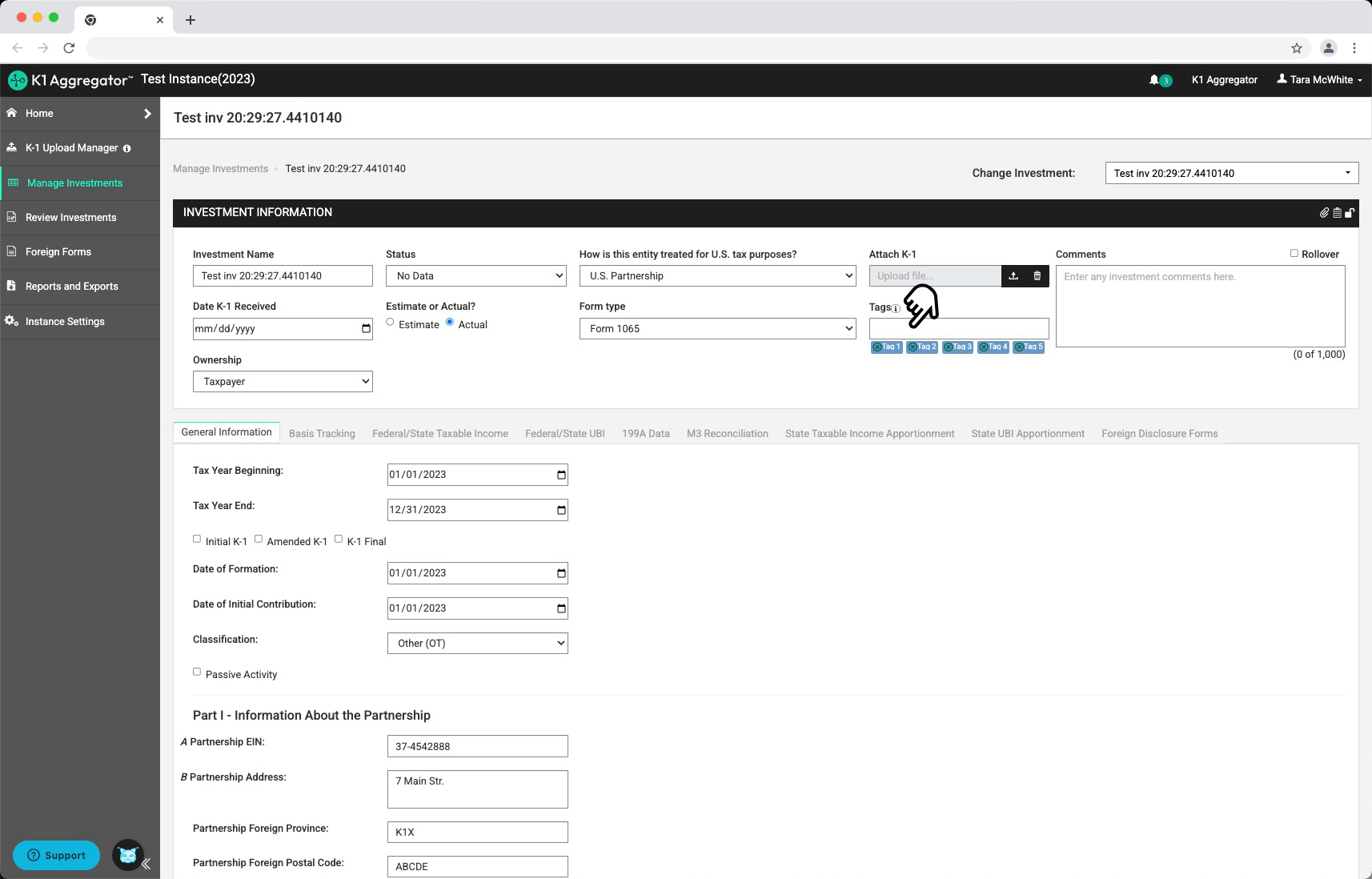
Tags can be used to segment investments in K1 Aggregator. There are two ways to add tags to your investments:
- Manually add tags to an investment in the 'Investment Information' section.
- Manage tags through import.
Manually Add Tags
Open an investment from the 'Manage Investments' list. Under 'Investment Information' section, add existing tags using "type ahead" and then clicking the tag you wish to apply.
To add new tags, type the tag into the tag field and hit the 'enter' button.
- Open an investment.
- Locate the Tags field.
- Enter a tag name.
- Press Enter.
Once created, the tag becomes available for reuse throughout the same taxpayer instance.
Import Tags in Bulk
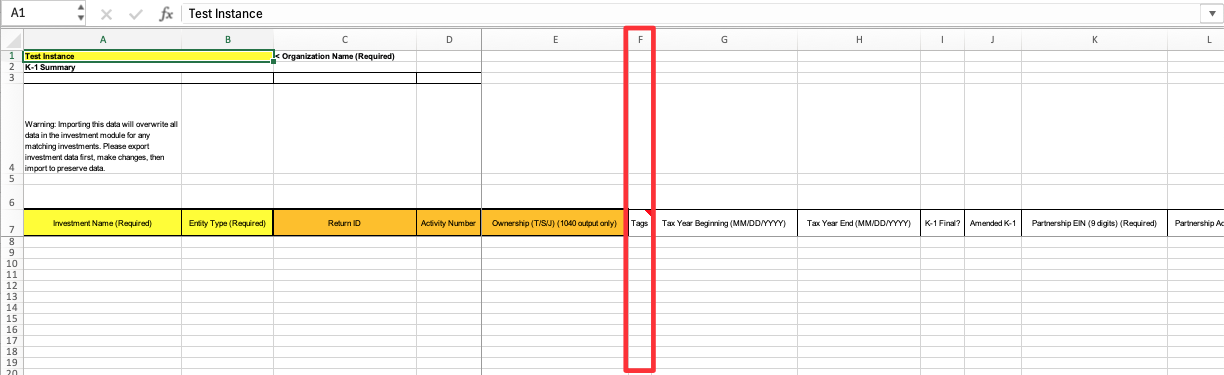
You can include tags in the import file by adding comma-separated tags in the 'Tags' column.
Update Investment Tags Using Import
You can also update the tags assigned to existing investments by importing an updated spreadsheet.
- Download the Standard Row Template.
- Update the Tags column using comma-separated values.
- Save the spreadsheet.
- Import the updated file back into K1 Aggregator.
Notes
- Importing updates the tags assigned to each investment included in the spreadsheet.
- Tags referenced in the import that do not already exist are automatically created and assigned to the applicable investments.
- Existing tags remain unchanged unless you modify the Tags value for that investment.
Best Practices
- Establish naming conventions before creating tags (plan your library).
- Use Tags to describe investment characteristics, not workflow progress.
- Use Statuses for review tracking and Tags for categorization.
- Keep tag names concise and consistent.
- Consider using Tags for fund families, business units, reviewer assignments, or general ledger groupings.
- Apply multiple tags when an investment belongs to more than one reporting group.
For further assistance, contact the K1x Support Team by clicking on the "Get Help" button on our apps or in our Help Center.